In these days’s rapid-changing digital world, organizations need bendy and scalable systems. That is where SOA OS23 comes in. It represents a current approach to software design that builds on provider-oriented structure (SOA) while integrating more modern technologies and practices.
You’ll examine what SOA OS23 is, its key capabilities, blessings, actual-global uses, and the demanding situations you have to bear in mind before implementation.
What is SOA OS23?
SOA OS23 is a complicated version or idea based totally on service-oriented architecture (SOA). It specializes in building software structures using small, unbiased services that speak with every different..
Every service plays a selected undertaking and may be reused throughout distinct packages.
Simple Example!
As opposed to building one huge device, SOA OS23 breaks it into components like:
- Consumer authentication carrier
- Fee processing carrier
- Notification service
These offerings work together but can also perform independently.
Key Features of SOA OS23
SOA OS23 introduces cutting-edge upgrades over traditional SOA. Right here are its fundamental features:
1. Modular Architecture
- Programs are divided into smaller offerings
- Every provider is independent
- Clean to replace or replace
2. Service Reusability
- Offerings can be reused throughout more than one structures
- Saves development time and fee
3. Platform Independence
- Works throughout special programming languages and platforms
- Helps integration with legacy systems
4. Cloud Integration
- Designed to work with cloud environments
- Helps scalability and far flung get entry to
5. API-Driven Communication
- Services speak using APIs
- Permits easy facts exchange
Benefits of SOA OS23
Adopting SOA OS23 can offer many blessings for businesses and developers.
Improved Scalability
- Without difficulty scale person services
- No need to scale the entire machine
Cost Efficiency
- Reuse existing services
- Reduce development and renovation prices
Faster Development
- Groups can work on exceptional offerings at the same time
- Quickens undertaking delivery
Flexibility
- Modify one service with out affecting others
- Smooth to add new functions
Better Security Management
- Apply protection at service degree
- Reveal and manipulate get right of entry to effortlessly
Real-World Applications of SOA OS23
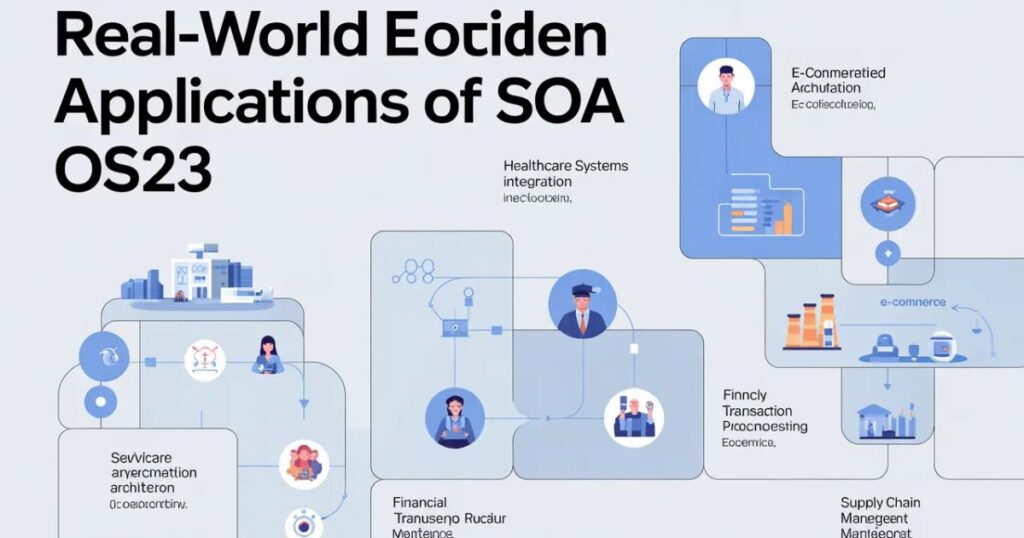
Banking & Finance
- Price processing structures
- Fraud detection offerings
- Purchaser account control
Healthcare
- Patient document structures
- Lab result sharing
- Appointment scheduling
E-commerce
- Order control
- Inventory monitoring
- Price gateways
Logistics
- Shipment tracking
- Warehouse management
- Direction optimization
What Role Is SOA OS23 Playing in Modifying the Software Industry?
SOA OS23 is transforming how software programs are designed and controlled.
1. Shift toward Microservices
- Encourages smaller, independent offerings
- Improves machine flexibility
2. Supports Cloud-Native Development
- Works well with cloud platforms
- Allows faraway and scalable packages
3. Enhances Integration
- Connects extraordinary structures without difficulty
- Supports APIs and third-party tools
4. Improves Team Collaboration
- Exceptional groups cope with different services
- Reduces dependency and delays
Step-by-Step: How to Implement SOA OS23
If you need to undertake SOA OS23, comply with those easy steps:
Step 1: Analyze Business Needs
Discover methods that can be changed into services
Step 2: Design Services
Smash your device into small, achievable offerings
Step 3: Choose Technology Stack
Choose equipment, frameworks, and cloud systems
Step 4: Develop APIs
Create APIs for communication among services
Step 5: Test Services
Make certain every carrier works independently
Step 6: Deploy and Monitor
Deploy services inside the cloud
Reveal performance and security
Comparison Table: Traditional SOA vs SOA OS23
| Feature | Traditional SOA | SOA OS23 |
|---|---|---|
| Architecture | Monolithic + services | Fully modular |
| Scalability | Limited | High |
| Cloud Support | Basic | Advanced |
| API Usage | Moderate | Extensive |
| Flexibility | Medium | High |
What Are the Major Challenges That Come Up When Implementing SOA OS23?
At the same time as SOA OS23 gives many advantages, there are also challenges to take into account.
Complexity
- Managing multiple offerings may be tough
- Requires proper planning
Integration issues
- Connecting offerings may also require superior tools
- Compatibility issues can arise
Security dangers
- More services mean extra access points
- Calls for robust safety features
Preliminary fee
- Setup and migration may be highly-priced
- Calls for skilled builders
Monitoring & Management
- Want tools to tune service performance
- Calls for continuous monitoring
Showing Best Practices for Using SOA OS23
To get the best consequences, observe these hints:
- Use clear carrier limitations
- Hold right documentation
- Put in force robust security protocols
- Use automation gear for deployment
- Monitor performance regularly
Conclusion
SOA OS23 is a present day method of software program architecture that allows agencies to build flexible, scalable, and green systems. by way of breaking programs into smaller offerings, it allows faster development, easier upkeep, and higher overall performance.
However, like several technology, it comes with demanding situations which include complexity and initial prices. With right planning and exceptional practices, SOA OS23 can significantly improve how software program structures are designed and managed. In case you are seeking to modernize your applications, SOA OS23 is truly well worth considering.
FAQs
Q. What’s SOA OS23 used for?
It is used to build scalable and bendy software program structures the usage of independent services.
Q. Is SOA OS23 the same as microservices?
Not exactly, however it is carefully related. SOA OS23 regularly consists of microservices principles.
Q. Is SOA OS23 appropriate for small companies?
Yes, but it relies upon on project size and price range.
Q. Does SOA OS23 require cloud computing?
Not obligatory, however it really works first-rate with cloud environments.
Q. What skills are wanted for SOA OS23?
- API development
- Cloud computing
- Device layout
- Protection management